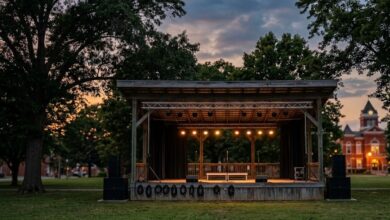
Forty-Five Seasons In, and It Still Does Not Have a Room of Its Own
Most American cities that support a professional orchestra eventually build it a house. A hall with a name on it, a lobby, a donor wall, acoustics somebody was paid a great deal of money to tune. Murfreesboro has supported a professional orchestra for forty-five years and has never built it anything. The Tennessee Philharmonic plays in churches, in an arts center on the Square, at a battlefield, at the farmers market.
Season 45 opens on October 27, and it is worth looking at where the concerts actually land, because the venue list tells you more about this orchestra than the repertoire does.
The season, date by date
Chamber Series — Tuesday, October 27, 7 p.m. at the Center for the Arts, 110 W. College St. Tickets $35. This is the new-ish smaller-format strand, and the Center for the Arts is the most intimate room the orchestra uses all year.
Veterans Salute — Friday, November 6, 7 p.m. at First United Methodist Church, 265 W. Thompson Lane. Tickets $10 to $40. The Masterworks Series opener, and the one with the most direct claim on this town's sense of itself.
Christmas Spectacular — Thursday, December 3, 7 p.m. at Belle Aire Baptist Church, 1307 N. Rutherford Blvd. Tickets $10 to $40.
Chamber Series — Thursday, February 11, 7 p.m. at the Center for the Arts. $35.
Chamber Series — Saturday, March 20, 11 a.m. at the Center for the Arts. $35. Note the daytime start — an eleven o'clock concert is a rare and genuinely useful thing for anyone with small children or an early bedtime.
Season Finale — Thursday, April 22, 7 p.m. at Belle Aire Baptist Church. $10 to $40.
A season ticket covering the Masterworks concerts runs $120. Individual programs are still being finalized, so the specific works on each night are yet to come.
It started as a university ensemble in 1981
The orchestra was founded in 1981 by Dr. Laurence Harvin, under the considerably less glamorous name of the University Community Ensemble — a fair description of what it was, a group drawn from campus and town playing together because there was nobody else doing it. The name changed to the Tennessee Philharmonic Orchestra as the ensemble grew past its origins. Harvin is still involved as founder and executive advisor; Jane McNulty serves as CEO and president.
Two facts about the organization are worth sitting with. It is fully professional — the players are paid musicians, not volunteers. And it is financially self-sustaining. For a regional orchestra in a metro dominated by Nashville's cultural gravity, in an era when orchestras considerably more famous have had genuinely bad decades, those two things together are not a small achievement.
The advantage of not having a hall
There is a version of this story that reads as a deficiency — forty-five years and still borrowing rooms. The orchestra has plainly decided to read it the other way.
Not owning a building means the ensemble can turn up where people already are. It plays at Stones River Battlefield, in city parks, at village venues, at the farmers market. Its stated purpose runs toward improving quality of life through awareness of the arts and getting the community involved rather than toward filling a specific number of seats on a specific number of nights. An orchestra with a hall has to fill the hall. An orchestra without one can go looking for an audience.
It also keeps the ticket honest. Ten dollars gets you into a professional orchestra concert in Rutherford County. There are not many rooms in Middle Tennessee where that sentence is still true.
Before the downbeat
The Chamber Series concerts put you a block off the Square, which is convenient — dinner beforehand is easy. Our guide to the best restaurants on the Murfreesboro Square covers the walkable options, and if you would rather sit down to something specific, we have broken out Italian and sushi separately.
Tickets and program updates come from the orchestra directly as each date approaches.