Fifty Years of Cannonsburgh: Murfreesboro’s Pioneer Village Turns the Same Age as Its Bicentennial Roots
Most people in Murfreesboro have driven past Cannonsburgh Village a hundred times. It sits just off Front Street near the Greenway, a cluster of weathered log cabins and clapboard buildings that most of us file away as “that old pioneer place” and never actually stop to see. This year is a good excuse to change that. Cannonsburgh is turning 50 — and its birthday is tangled up with two much bigger ones.
The village was born in 1976, built by a committee of local volunteers to mark the United States Bicentennial. It opened to visitors that July, conceived as a walk-through snapshot of daily life in this part of Tennessee from the early 1800s through the 1940s. Five decades on, it has grown into roughly 20 structures and a collection of more than 2,000 artifacts — a gristmill, a one-room schoolhouse, a chapel, a doctor's office, a blacksmith shop and the kind of everyday tools and furnishings that don't survive in most places.
A name older than Murfreesboro itself
The village's name is its own history lesson. When the town was first laid out in 1811 on land donated by Revolutionary War officer Colonel William Lytle, the state legislature christened it “Cannonsburgh,” after a rising young politician named Newton Cannon. The name lasted all of about a month before it was changed to Murfreesboro, honoring Lytle's friend, Colonel Hardy Murfree. So when the Bicentennial committee went looking for a name in 1976, they reached back and dusted off the one the town wore for its very first weeks. It is a fitting choice for a place devoted to remembering what came before.
Murfreesboro, it's worth remembering, was no backwater in those early years. For eight years beginning in 1818, the town served as the capital of Tennessee, chosen largely for sitting near the geographic center of the state. Cannonsburgh keeps that frontier-era chapter within arm's reach in a city that has since sprawled into one of the fastest-growing in the country.
A 50th that lines up with a 250th
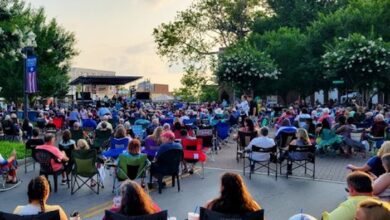
There's a neat symmetry to the timing. Cannonsburgh exists because of America's 200th birthday, and it hits its own 50th just as the country reaches its 250th in 2026. The village leaned into that this summer, marking the milestone with a community celebration that filled the grounds — bluegrass drifting from the gazebo, gospel music in the chapel, a quilting bee, blacksmithing demonstrations, and a display of Cannonsburgh-inspired paintings from the Murfreesboro Art League.
Some of that effort is still there to see. The grounds got a fresh spruce-up for the anniversary, patriotic bunting went up across the porches, and the village's Hanes Museum reopened as part of the festivities. Admission to walk the grounds is free, which has always been part of the appeal — it's the rare local attraction you can visit on a whim, with kids in tow, without buying a ticket.
Worth a stop
Fifty years is a long time for a volunteer-built village to survive, let alone stay standing in the middle of a boomtown. Cannonsburgh has done both. On a slow summer evening, with the light going gold over the cabins and the gazebo, it's an easy reminder that Murfreesboro's story didn't start with the shopping centers and the interstate ramps. It started right here — under a name the town only kept for a month.