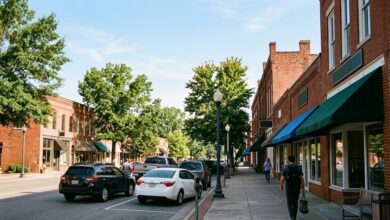
Murfreesboro Lands Among America’s New Boomtowns
For anyone who has watched cornfields turn into subdivisions and two-lane roads swell into five-lane arteries, the news will not come as a shock. This summer, a national study confirmed what rush-hour traffic on Old Fort Parkway has been shouting for years: Murfreesboro is one of America's new boomtowns.
The ranking, published by the financial-data firm SmartAsset, sifted through more than 400 U.S. cities with at least 65,000 residents and measured five years of growth across three yardsticks — housing stock, the size of the local labor force, and total economic output. The 75 cities that scored highest earned the “boomtown” label. Murfreesboro landed at No. 25.
The numbers behind that ranking are striking. Over the study's five-year window, the city's housing supply expanded by 20 percent while its labor force grew by 21 percent, and the local economy posted annual growth of 4.7 percent. Put plainly: roughly one in five homes and one in five workers in Murfreesboro today weren't here half a decade ago.
Growth, of course, is not new to this Rutherford County seat. Founded in 1811 and briefly the capital of Tennessee before the seat of government moved to Nashville in 1826, Murfreesboro has long traded on its position near the geographic center of the state — a distinction marked by a small monument just east of town. For much of the twentieth century it was known chiefly as a college town, home to what is now Middle Tennessee State University, the largest undergraduate university in the state. But the past two decades have rewritten the script, as families and employers priced out of Nashville looked 35 miles down Interstate 24 and found room to grow.
Murfreesboro is in good company, and not only nationally. The strongest booms in the study clustered across the South and West, with Texas and Florida dominating the top of the list; Georgetown, Texas, claimed the No. 1 spot, followed by New Braunfels, Texas. Closer to home, Murfreesboro was one of four Tennessee cities to make the list, joining Clarksville, Franklin and Knoxville — a Volunteer State showing that underscores how much of the nation's migration is now pointed toward the mid-South.
Being a boomtown is a double-edged distinction. The same growth that fattens the tax base and lures national retailers — a steady wave of new stores, restaurants and grocery anchors has followed the rooftops — also strains roads, schools and the patience of longtime residents. City leaders have answered with a building spree of road-widening projects and a record capital budget, betting they can pave and plan fast enough to keep pace. Whether Murfreesboro can keep growing without shedding the small-city character that drew people here in the first place is the question the next five years will answer.
For now, the ranking is a milestone worth marking: a town that once measured itself against Nashville is increasingly a destination in its own right — No. 25 on a national list, and still climbing.