It Went Under Broad Street in the 1950s. This Fall It Comes Back Up.
Autumn officially arrived in Rutherford County this week, which matters more than usual this year, because the city has spent two construction seasons aiming at exactly this stretch of the calendar.
Town Creek — a waterway most residents have never seen, because for roughly seventy years it has not been visible — is supposed to be back in open air by fall.
How a creek disappears
The short version is that Murfreesboro did what nearly every growing American town did in the middle of the twentieth century: it treated a stream as a drainage problem rather than an asset. Through the 1950s and 1960s, as Broad Street was built and rebuilt into the commercial spine of the city, Town Creek was buried — routed into concrete culverts and a run of corrugated metal pipe, and paved over.
It never stopped flowing. It just stopped being a creek anybody could stand next to. Underground, it still runs from Murfree Spring — the spring behind the Discovery Center, which shares its name with the town — down to Cannonsburgh Village, where it meets Lytle Creek.
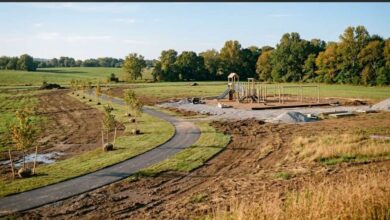
That is the line the city has been reopening. The work is called daylighting, which is exactly what it sounds like: taking a piped stream out of its concrete sleeve and giving it back a streambed, banks, plantings and sky.
What is actually being built
Daylighting began in mid-2024 on a project the city has priced at roughly $22.5 million, with the majority of the money coming from federal stimulus funds tied to its stormwater elements. City leaders have said the core structure of the revitalized creek and much of the landscaping would be finished by this fall.
The creek is the headline, but the connective tissue is the part that will change how people move through downtown. The plan includes new green space, walking trails and seating along the corridor, plus a pedestrian bridge over Broad Street — linking the downtown side to the low-lying area locals have always called The Bottoms — and crossings that carry the path above Northwest Broad and South Church.
Put plainly: when it is done, you will be able to walk from the Discovery Center and the Murfree Spring wetlands all the way to Cannonsburgh Village without taking your life in your hands crossing Broad.
Why that is a bigger deal than it sounds
Murfreesboro already has a greenway system that people genuinely use — miles of it, with trailheads scattered across the city. Our guide to the greenway's trailheads lays out how much ground it already covers.
What the system has never had is a good downtown spine. The Stones River and Lytle Creek sections are terrific and they are also, mostly, somewhere else. Town Creek stitches the historic core into the network — which is the difference between a trail you drive to and a trail you walk onto.
There is a nice symmetry in the destination, too. Cannonsburgh Village, the city's reconstructed pioneer settlement, sits at the downstream end. A creek that got buried in the name of mid-century progress will now deliver people to a place built to remember what came before it.
What to watch for
Fall is the target for the core structure and most of the planting, not necessarily for ribbon-cutting on every amenity. New streambanks also need a growing season or two before they stop looking like a construction site and start looking like a creek.
Still — if you have driven past the fencing along Broad Street for two years wondering what exactly was being dug, this is the season you find out.